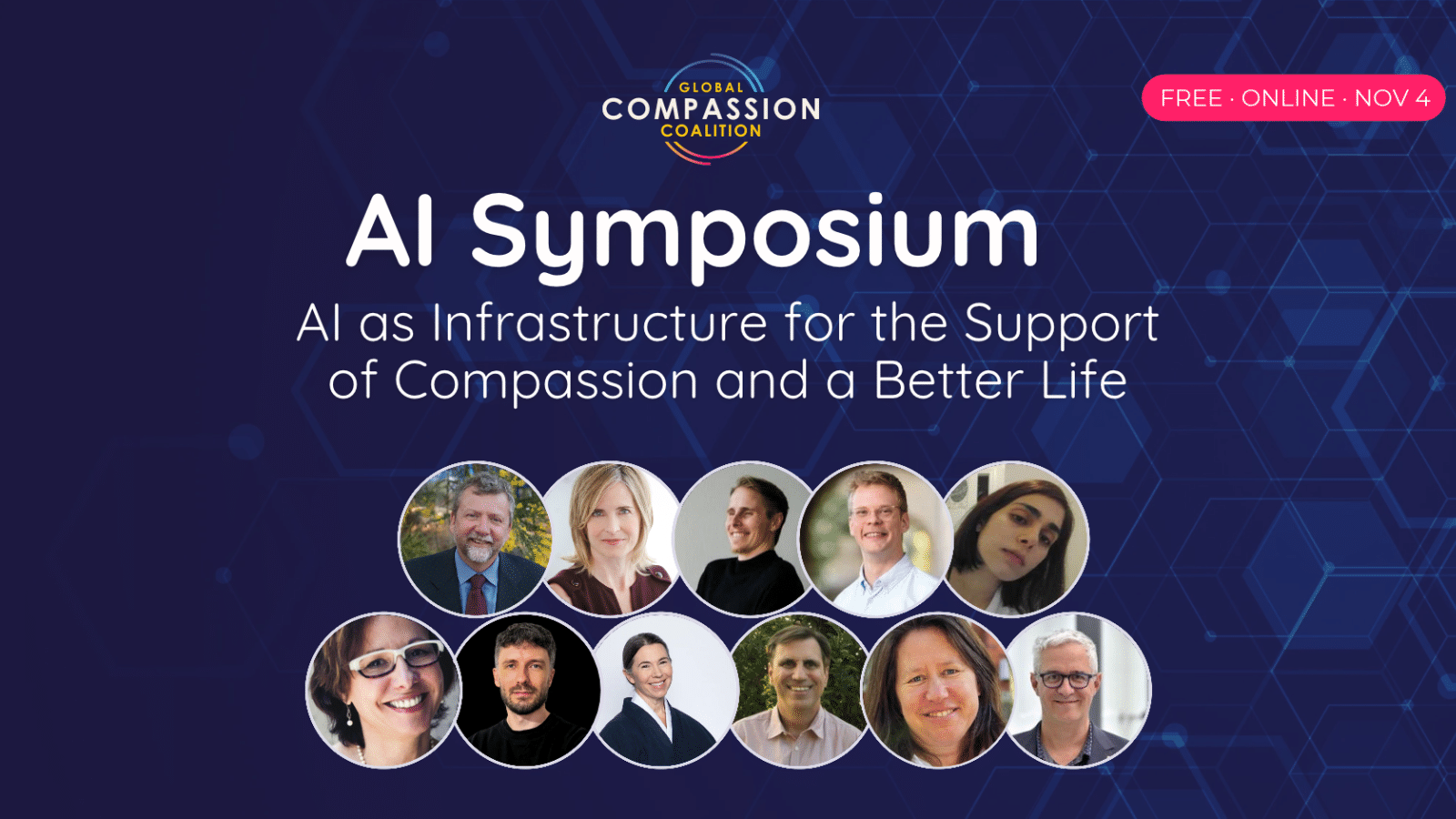
Global Compassion Coalition – AI Symposium
Date: Wednesday, November 4
Time: 11am – 1pm PT / 2pm – 4pm ET / 7pm – 9pm UK
AI as Infrastructure for the Support of Compassion and a Better Life
AI is rapidly changing how we live, work, learn, and connect. Alongside the questions of what AI can do and how quickly it can advance, I think there’s another important conversation to have: how might AI support better lives and a more compassionate, connected society?
On November 4, I’ll be joining the Global Compassion Coalition for AI as Infrastructure for the Support of Compassion and a Better Life, a free online symposium bringing together researchers, technologists, educators, and compassion and social-change leaders to explore these questions.
Across two panels, we’ll look beyond the fear and hype to consider the opportunities and limitations of AI, what is already being done to orient it toward prosocial values, and the choices we can make now to help shape its direction.
At the heart of the conversation is a very human question: how can AI support compassion, fairness, dignity, connection, and human flourishing?
Panel 1 – What Is Being Done Now to Align AI in a Prosocial Direction?
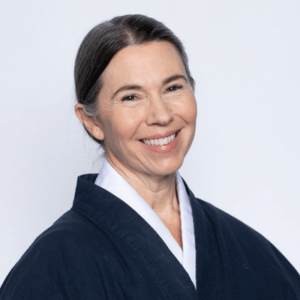 Sessei Meg McNeil – Moderator has practiced Soto Zen for over 30 years and currently serves as Head of Practice at Tassajara Zen Mountain Center, the monastic branch of the San Francisco Zen Center. Alongside her Zen training, she helped develop the Search Inside Yourself Leadership Institute, which grew out of the mindfulness-based emotional intelligence and leadership program created at Google, and has worked extensively in the intersection of tech and Buddhist-inspired practices.
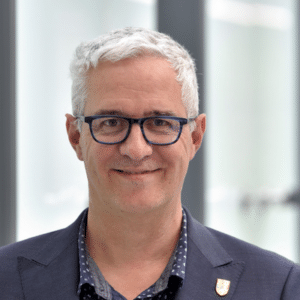 Rafael Calvo, PhD is Chair of Design Engineering and Director of the Wellbeing Technologies Lab at Imperial College London’s Dyson School of Design Engineering. A former ARC Fellow at the University of Sydney, he has published 3 books and over 250 papers (citations: 23,000; h-index: 73). His research focuses on intelligent systems for wellbeing, health, and learning, combining NLP, affective computing, VR, and human-centred design. Notable projects include mental health platforms, apps for asthma and conversational agents for dementia. His work has attracted over $10M in funding and improved lives across diverse populations.
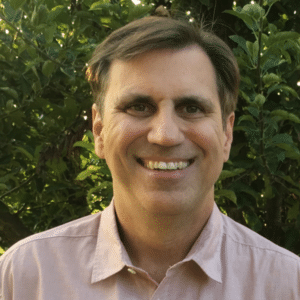 Mark Graves, PhD, is Research Director at AI and Faith and Research Associate Professor of Psychology at Fuller Theological Seminary. His research explores the intersection of artificial intelligence, ethics, and theology. He holds a PhD in computer science specializing in artificial intelligence and an MA in systematic and philosophical theology, with additional fellowships spanning genomics, moral psychology, and moral theology. Alongside his academic work, Mark brings 15 years of experience developing AI and data solutions across the biotech, pharmaceutical, and healthcare industries. He has held teaching or research positions at eight institutions and authored more than ninety technical and scholarly publications, including three books.
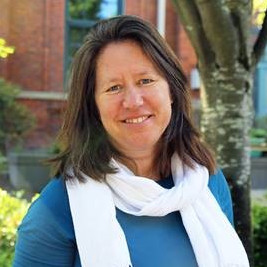 Jane Compson, PhD, is Associate Professor at the University of Washington, Tacoma, where she teaches religious studies and philosophy. Her research explores contemplative practices and Buddhist thought in contemporary secular contexts, including artificial intelligence ethics, medical ethics, and education. She is a trained teacher of Compassion Cultivation Training (CCT) and Mindfulness Based Stress Reduction (MBSR), and a Buddhist chaplain with lay ordination from the Zen Peacemaker Order. Jane is also a Research Fellow with AI and Faith, bringing the wisdom of faith traditions to conversations around AI ethics, and is currently writing a book on Buddhism and AI.
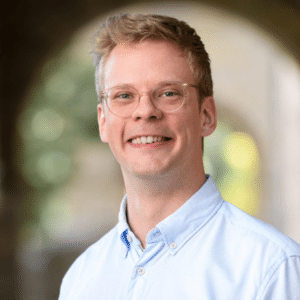 Max Lamparth, PhD, is a Research Fellow at Stanford University with the Hoover Institution’s Technology Policy Accelerator, the Stanford Intelligence Systems Laboratory, and the Stanford Center for AI Safety. His research develops methods to ensure AI models learn desirable behavior from human input and that they learn goals robust to exploitation. Prior to his current appointment, Max was a postdoctoral fellow at Stanford University and received his Ph.D. from the Technical University of Munich.
Panel 2 – What Can We Do Collectively to Nudge the Evolution of AI in Prosocial Ways?
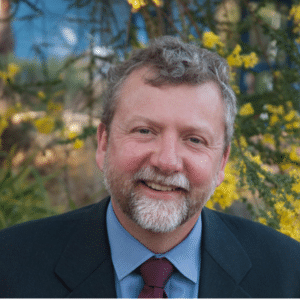 Paul Atkins, PhD, is an author, researcher and facilitator trainer whose research focuses on enhancing compassion, wellbeing, perspective-taking, and cooperation in groups and organisations. He co-founded ProSocial World, a not-for-profit strengthening cooperation and trust in purpose-driven groups globally, and has applied ACT and ProSocial in settings as diverse as private companies, political parties, schools, and the United Nations. A former President of the ANZ Association for Contextual Behavioral Science and a Fellow of the international ACBS, Paul now writes on AI alignment, exploring how technology can strengthen rather than erode human wisdom and cooperation. He lives in Sydney, Australia.
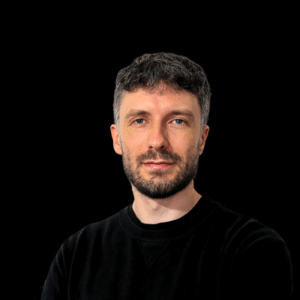 Adam Elwood, PhD is Director of GenAI at Aily Labs, where he leads a team building agentic decision-intelligence systems for Fortune 500 companies. He holds a PhD in Physics from Imperial College London, where his research was based at CERN. His current work bridges enterprise AI and alignment research: he is a co-author of “Positive Alignment: Artificial Intelligence for Human Flourishing” (with collaborators from DeepMind, OpenAI, and Anthropic), and collaborates on contemplative AI benchmarking. A longtime meditation practitioner, Adam writes about consciousness and value on his Substack, Pursuing Reality.
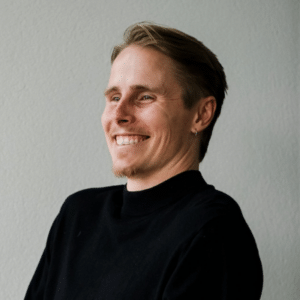 Ruben Laukkonen, PhD is a senior neuroscientist at the University of Oxford, where he directs the Flourishing Intelligence Program (FLIP) and co-directs the Centre for Eudaimonia and Human Flourishing. Ruben has made significant theoretical and empirical contributions to the cognitive neuroscience of consciousness, meditation, and insight. His work also reveals a pathway towards better and safer artificial intelligence based on the science of consciousness and contemplative wisdom. His work has been featured widely, including The New York Times, TIME, Scientific American, TEDx, Vice, ABC, Aeon, VOX, New Scientist, and in the Nature collection.
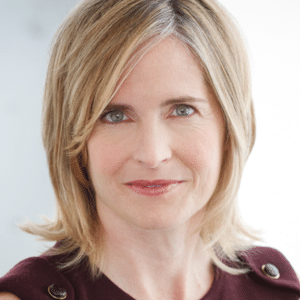 Stacey Lawson works at the intersection of AI, social impact, sustainability, and transformative leadership. She is Co-founder of Positive AI Labs, focused on Wisdom + AI, and the Benevolent AI Future coalition, bringing together builders and funders of AI solutions serving the public good. She recently co-chaired ISL.ai with Sir Richard Branson, an AI Summit on Necker Island for leading AI founders and CEOs, and advises several AI startups. Previously, Stacey co-founded and led Ygrene Energy Fund and co-founded UC Berkeley’s Sutardja Center for Entrepreneurship & Technology. A longtime practitioner and teacher of inner transformation, she facilitates explorations of conscious business, group coherence, self-realization, and awakening practices
 Roma Patel is a Research Scientist at Deepmind, where her research focuses on safety, alignment and understanding of language models. She has also done work on grounded language learning and robotics focused on building agents that exhibit human-level intelligence to cooperatively solve tasks by using insights from the study of language. Given the interdisciplinary nature of this research agenda, Roma’s research spans the fields of natural language processing, robotics, multi-agent reinforcement learning and cognitive science. Her work has been published at top-tier conferences such as ICLR, ICML, RSS, ACL, EMNLP and others.