A reflection on the slow power of ethical discourse, and the persisting need for religious AI ethics.
To be, or not to be, ethical?
In both public discourse and in academic AI ethics literature, it has long been widely acknowledged that there is a wide gap between AI ethical principles and AI practice.1 What’s worse, one way to characterize the practical development of the field has been a move from widespread “ethicswashing”, when ethical principles were used as a fig leaf by corporations that never had any intention of paying attention to them, to a subsequent phase of “ethicsbashing”. While these dynamics were first named six long years ago, the patterns identified there have continued to mark trends in AI ethics.
In this more “advanced” phase of ethics bashing, prominent figures sometimes flaunt their disregard for any kind of AI ethics, and insist that at least they are straightforward about their depravity. It is enough to lead plenty of people to question the whole enterprise of a public ethic.
Needless to say, the hope of AI ethicists was that the critique of “ethicswashing” would help emphasize the need for ethical practice aligned with clear ethical commitments expressed in accessible frameworks. The goal was not to fuel a cynical dismissal of ethics overall.2
This situation makes it tempting to fall into triumphalism, dissociation, distancing, or a laissez-faire technological fatalism, which treats AI development and uses as inevitable. Here, I articulate a difficult and narrow path through this terrain: one that is engaged, earnest, critical, ethically committed and also ethically pluralist. It involves serious, earnest ethical reflection and commitment that is manifested in and supported by appropriate follow-through at both personal and group scales.
I’m encouraged in this by the fact that many continue to contribute to the essential work involved in moving from ethical frameworks to practice, including in public policy. Ethical convictions and ethical conflict have deeply structured the field of AI development, especially through the well-documented channel of staff leaving organizations and joining others over issues of ethical alignment. Whistleblowing within AI companies has been a constant, and the result has been a public that is much more skeptical, concerned, and informed than they might otherwise be. This affords crucial opportunities for a more open and honest approach to the technology than we might have had otherwise.
Contrary to those who would depict ethics as unimportant, ethics is integral to group formation and maintenance. It also shows up organizationally in the capacity to recruit, train, retain and motivate teams.3 These realities are documented in many places, but should be especially prominent in our thinking about AI; they are one of the primary reasons that OpenAI spawned Anthropic, now one of its main competitors.4
So I acknowledge and appreciate the critical response, but move forward with the hope that there are enormous resources to help us resolve the practical ethical quandaries raised by AI.
Clarifying Relationships Between Ethic(s), Governance and Management, in Relation to Faiths
Conceiving of ethics, governance and management as distinct “pace layers” helps frame this discussion in a fruitful, constructive, and perhaps ultimately hopeful way. This framing specifically offers a perspective on how ethics can make contributions that are highly efficacious, even if they are sometimes slow to appear.
“Pace layers” is a concept from Stewart Brand’s work in “How Buildings Learn”.5 The basic idea is that the lower levels are more foundational, which means that they usually change more slowly and that the higher layers also always already depend on them. The basic concept has proven enduringly useful when thinking about technology design and integration, especially in the field of information architecture, which draws on architectural insights to understand information systems.6
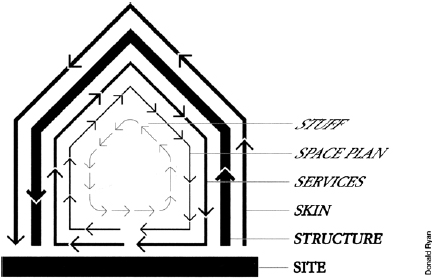
Figure 1: Cited from Steward Brand, “ Pace Layering: How Complex Systems Learn and Keep Learning” https://longnow.org/ideas/pace-layers/
I often tell the following micro-story to capture the idea of pace layers:
One day a woodcutter climbed a mountain and cut down a tree. He said, “I chose to cut down this tree here.” But the mountain replied, “No, I put the tree there in the first place.”
Of course, the combination of the fast, managerial decision and the slow geological and environmental processes converged to create both the choice architecture and the specific decision. But the slow process which powerfully creates conditions that are also especially difficult to alter or reverse is also often invisible. Ethics is something like that mountain.
The following diagram uses the pace-layer concept to frame conversations about the relationships between AI ethics and AI governance from secular and religious perspectives. The rest of the article is about helping make sense of, and contextualizing, this pace layering frame.
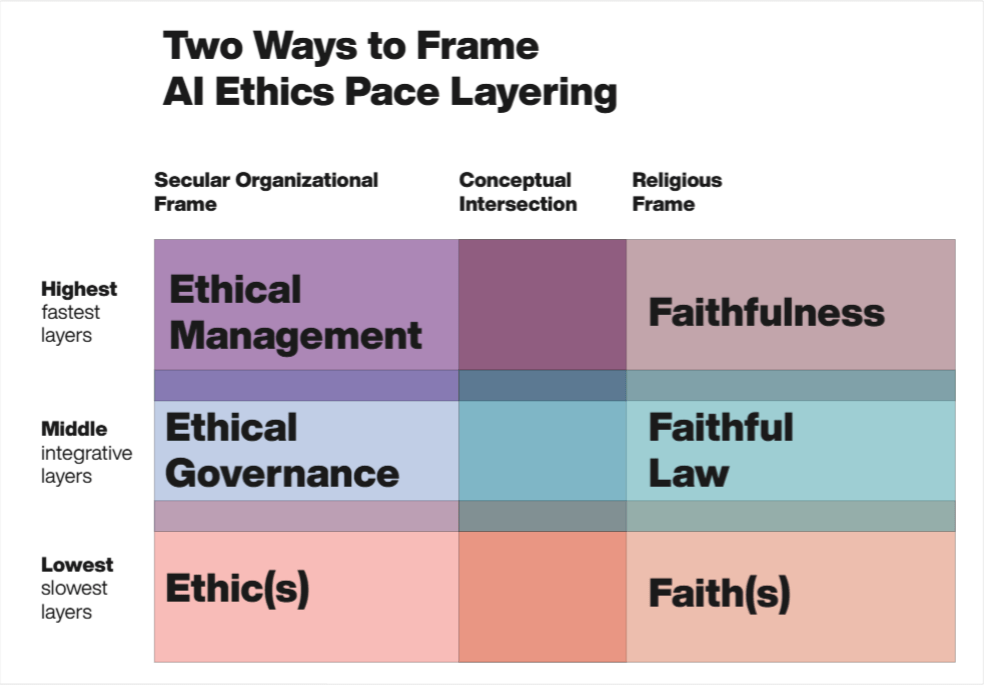
Consider that if AI ethics frameworks form the lowest and slowest pace layer, the lack of immediate change is not a reason to abandon the effort. Rather, the proper role of ethics is seen insofar as it provide deep, enduring, underlying grounding for the development of governance tools such as laws, policies, and procedures. This governance layer understandably needs to change more quickly than the ethics layer, in order to adapt to shifting technological and institutional realities. However, the ethics provides an enduring basis that can guide, ground and provide coherence and continuity to these changes. It provides a stable “why” beneath the “what” of various policies.
The relationship between governance and implementation, including the management of entities such as businesses, non-profits, and government agencies, is similar. The policies and procedures of governance provide a relative level of applied stability for those who are engaged in day-to-day management. It changes more rapidly than the governance layer, and that is also why it depends on the stability that governance provides.
Much more can be said about this, and this relates to a wide range of academic and professional literature in interesting ways. For our purposes here, note that “Ethic(s)” is being used in a way that emphasizes that there are a variety of ethics, or ethoses, that different groups can have and maintain. This choice of language captures, in a few terms, the relatively recent emphasis in global AI ethics literature on a more concerted effort to seriously wrestle with the divergent frameworks that are guiding AI use. This includes both divergent frameworks and divergent meanings assigned to similar terms (such as privacy), even when the same language is used across frameworks.7
This emphasis on the challenges of ethical pluralism is an occasion to point towards a distinct, if clearly related, form of pluralism: interfaith pluralism. Notice that the idea of “faith(s)” can be used in a way that is substantially similar to “ethic(s)” in this sense. This, then, provides a valuable bridge between the realm of AI ethics, and the realm of theological/religious ethics.
The Bridge and the Diet of Canned Worms
The bridge between disparate ways of thinking through AI ethics is, on one level, reasonably simple and clear. In a world that was not marked by all kinds of ethical conflict, including conflict about the many ways in which religious faiths and positive law interact, it might be a reasonably straightforward exercise to discuss the relationship between these religious and secular framings.However, we live in a world where ethically-rooted conflict and religiously-related conflict are of great historical and current significance. The widespread sense that religion and state should be, or are, fundamentally separate is an important feature of much of the global ethics landscape. To open this discussion is, therefore, to open a lot of cans of worms.
One of the widest and deepest taproots of religious conflict, as well as efforts at religious reconciliation, involves the Protestant Reformation. We might fittingly center the Diet of Worms of 1521, here, and not only because it makes an excellent dad joke. This was the moment when Luther, already excommunicated by the papacy, was examined, pressed to recant, and declared a heretic under imperial law. The condemnation itself took the form of the Edict of Worms, issued in the name of Emperor Charles V.8
Catholic teaching and canon law, as an expression of Catholic faith, had already established and permeated this process before the imperial Diet convened, so that the slow, foundational layer of Catholic faith and canon law shaped the faster machinery of imperial governance and the practical management of the machinery that (only partially) managed to restrict and punish him. This illustrates just the kind of pace layering that I am discussing.
In addition to illustrating the pace layer concept, this case also highlights the truly ethical nature of the conflict. Catholics condemned “heretics” like Luther to a substantial degree because many of them thought that it was the right thing to do. Contrary to framings which treat this merely as being about face-saving or control, there is abundant evidence that explicit, conscious, earnestly held ethical views were essential to these historical processes.
It isn’t that those who violated current Catholic and Protestant norms in support of freedom of religion distastefully used coercion contrary to conscience because of cynical considerations. For many, as much as the punishment may have been either distasteful or delightful, it was felt to be right, just and decent. We can look at Aquinas’s explicit arguments in favor of it, to take one prominent example among many, to illustrate why it should qualify as an example of ethics, as opposed to instrumental cynicism.9
This is uncomfortable for many of us to sit with, including me. Personally, I embrace the hard-won commitments to freedom of religion that have emerged, often slowly and with difficulty, in a variety of religious traditions. Nonetheless, I also think it is essential to acknowledge the centrality of ethical reflection and argumentation to systems of persecution, if we are to understand the importance, power, and risks of ethics.
The condemnation and sanctioning of killing of heretics was ethical in a variety of senses. In a minimal sense, it involved explicit normative claims, and was aligned with the ethos of both Catholics and of many Protestants. It was therefore also broadly ethically aligned across various groups in its environment. These convictions were not only sincere, but also broadly held across different groups. Additionally, notwithstanding my objections to many of the arguments, it was grounded in a general scope of ethical concern in certain ways. A longer discussion, with qualifiers, could help articulate why I consider this position less ethical than those which respect freedom of conscience, but that is not a short journey.
Here the point I wish to make about ethics and pace layers is this: in some parts of the world public policy continues to enforce freedom of conscience and forbid persecution of heretics based on ethical changes that remain relatively influential in some places, at the moment. However, more coercive ethical norms might slowly replace more open and tolerant ones. That moves us toward a world where we can reasonably expect the governance mechanisms based on these more tolerant and open ethics to be steadily eroded. It is something like a house whose foundation is rotting beneath it. We should not be confident that laws can consistently withstand an erosion of their ethical foundations.
In light of this, the work of historical reconciliation takes on an enduring importance and urgency. Relatively recent ecumenical rapprochement between Lutherans and Catholics has substantially involved discussions around the meanings of grace, faith, and related authoritative Biblical interpretations.10 Post-Vatican II Catholic values in general reclaim and build upon an ethical frame of discourse, the roots of which permeated both Catholic and Protestant ethical-governance-and-management systems throughout the Reformation and Counter-Reformation. It is of great importance that those themes deeply permeate documents such as “Magnifica Humanitas”.11
An ethical warrant of discourse is far from a guarantor of ethical rightness, ethical unity, or the other things towards which ethical discourse aims. Still, it is enough, for me, that ethical learning is more likely to be achieved if we try to provide discursive warrant, and that we are more likely to learn and change and understand and experience agency (as an expression of our divine image-bearing) if we at least try. In the long arc of history, I find the turn from persecution of heretics toward theological discourse and reconciliation to be a hopeful, precious, fragile and mighty thing. To emphasize its importance as highly as I can in the terms of my own theological commitments and convictions, I think discourse is cruciform. On the other side of its difficulties, there really can be new life.
It is far beyond the scope of this article to detail these dynamics further, here. I bring them in to suggest that these discussions provide rich resources for conceiving of, and understanding, the relationships between various faiths (including various understandings of faith itself) and related governance processes. The depth, subtlety, complexity, richness, and explosiveness of the related historical processes should be openly noted and discussed. These issues illustrate that the problems here can easily be classified as wicked ones: they do not admit of easy or clear solutions.12
That acknowledgment leads us very quickly from the realm of technocratic dreams back into the grounded world of history, in all of its difficulties.
Conclusion
Here, I have slapped together one possible bridge, among many, between practical secular AI ethics and practical AI theoethics. It is worth evaluating thoughtfully and critically on many levels, and perhaps much better and sturdier conceptual bridges can be built by those who wish to do a better job of it.
The notion of bridging secular and religious discourse is not only a conceptual one. It is also a question of will. I understand and sympathize with those who are not eager to build or cross a bridge to a place where the diet does seem to consist of cans of worms.
My resistance to this separating impulse starts with this: a “techno-fix” for ethical conflict is simply not to be found; it is a category mistake to imagine that it could be.13 This means that the path toward clarity in our AI ethics must pass through the difficulties of our ongoing history, which is often heavily religious and theological even if it would be simpler to imagine these challenges away.
I would add an enduringly hopeful note to this negative one. I think that theological resources are of enormous value when thinking through the challenges of our pluralistic world, including within the conflicts that have unfolded internally in them. I offer the long and ongoing arc of Catholic and Protestant reconciliation as one illustration of this.
This history reminds me that the wisdom of the world’s religions is not a body of static thought embedded within categories such as “Christian” or “Jewish” or “Hindu”. Rather, it surfaces first when we begin to understand how intensely dynamic these categories are, both internally and in their complex relationships. Religions have a reputation for static immutability, and this is an image that religious practitioners have often worked to cultivate. Reflection on and study of our faiths through examples like the Diet of Worms helps us see that religion has often been more productive, generative, exciting, and also dangerous, than the staid image suggests.
The internal dynamism and conflict that characterizes faith traditions are also a resource for ethical development and theological development. These kinds of developments nourish and sustain interfaith and secular-religious discourse as well.
With all of this context in view, I would invite you to take one more look at the diagram that I have provided. Although I have only offered a few small gestures here, I hope that you can now look at it with fresh eyes:
What I see here, when I consider the frustrations of ethicswashing and ethicsbashing and ethical pluralism that have arisen for the AI ethics community, is something fearful indeed. And in that fear, I also see the potential for the beginnings of wisdom.14 If we ultimately fear doing wrong more than we fear other things, such as failing to turn a profit, I believe that we have the elements needed to really build up practical wisdom in the domain of AI ethics.
What emerges from this sort of reflection is no simple solution. Rather, it yields some clarity about the need that AI ethics has for sustained personal practice and deep interdisciplinary research in a wide variety of domains. These include ethics, religious studies, theology, law, social theory, philosophy, psychology, management, and more. The resources that are available are enormous, as are the challenges. If only we had machines that made it so that people could be freed up to spend time reflecting on themselves, their communities, their traditions, and the ways in which we might structure a common life together that is oriented towards our shared survival and flourishing.
Colophon: This essay is by Dan Heck. Its external citation apparatus was developed with AI research assistance (Claude, Opus 4.8) in Chicago/Turabian form, prioritizing openly accessible academic sources drawn from web search together with Heck’s research library, with historical corrections incorporated into the text and notes.This external apparatus uses standard academic (Chicago/Turabian) citation. All arguments, framing, and the decision to accept, revise, or discard any proposed citation remain Heck’s responsibility.
Bibliography
Aquinas, Thomas. *Summa Theologiae* II-II, q. 11, a. 3, “Whether Heretics Ought to Be Tolerated?” Translated by Fathers of the English Dominican Province. 2nd rev. ed. 1920. New Advent. Accessed July 20, 2026\. https://www.newadvent.org/summa/3011.htm](https://www.newadvent.org/summa/3011.htm.
Bainton, Roland H. Here I Stand: A Life of Martin Luther. New York: Abingdon-Cokesbury, 1950.
Bietti, Elettra. “From Ethics Washing to Ethics Bashing: A View on Tech Ethics from Within Moral Philosophy.” In Proceedings of the 2020 Conference on Fairness, Accountability, and Transparency (FAT* ’20), 210–19. New York: Association for Computing Machinery, 2020. https://doi.org/10.1145/3351095.3372860.
Brand, Stewart. “Pace Layering: How Complex Systems Learn and Keep Learning.” The Long Now Foundation, January 17, 2018. https://longnow.org/ideas/pace-layers/.
Coldewey, Devin. “Anthropic Is the New AI Research Outfit from OpenAI’s Dario Amodei.” TechCrunch, May 28, 2021. https://techcrunch.com/2021/05/28/anthropic-is-the-new-ai-research-outfit-from-openais-dario-amodei-and-it-has-124m-to-burn/.
Corrêa, Nicholas Kluge, Camila Galvão, James William Santos, Carolina Del Pino, Edson Pontes Pinto, Camila Barbosa, Diogo Massmann, Rodrigo Mambrini, Luiza Galvão, Edmund Terem, et al. “Worldwide AI Ethics: A Review of 200 Guidelines and Recommendations for AI Governance.” Patterns 4, no. 10 (2023): article 100857. https://doi.org/10.1016/j.patter.2023.100857.
Curry, Oliver Scott, Daniel Austin Mullins, and Harvey Whitehouse. “Is It Good to Cooperate? Testing the Theory of Morality-as-Cooperation in 60 Societies.” Current Anthropology 60, no. 1 (2019): 47–69. https://doi.org/10.1086/701478.
Ess, Charles M. “Interpretative Pros Hen Pluralism: From Computer-Mediated Colonization to a Pluralistic Intercultural Digital Ethics.” Philosophy & Technology 33, no. 4 (2020): 551–69. https://doi.org/10.1007/s13347-020-00412-9.
German History in Documents and Images. “Luther and Emperor Charles V at the Diet of Worms (1521).” German Historical Institute. Accessed June 20, 2026. https://germanhistorydocs.org/en/from-the-reformations-to-the-thirty-years-war-1500-1648/luther-and-emperor-charles-v-at-the-diet-of-worms-1521.
Hagendorff, Thilo. “The Ethics of AI Ethics: An Evaluation of Guidelines.” Minds and Machines 30, no. 1 (2020): 99–120. https://doi.org/10.1007/s11023-020-09517-8.
Henshall, Will, and Billy Perrigo. “Dario and Daniela Amodei.” Time, September 7, 2023. https://time.com/collections/time100-ai/6309047/daniela-and-dario-amodei/.
Hinton, Andrew. Understanding Context: Environment, Language, and Information Architecture. Sebastopol, CA: O’Reilly, 2014.
Jobin, Anna, Marcello Ienca, and Effy Vayena. “The Global Landscape of AI Ethics Guidelines.” Nature Machine Intelligence 1, no. 9 (2019): 389–99. https://doi.org/10.1038/s42256-019-0088-2.
Joint Declaration on the Doctrine of Justification by the Lutheran World Federation and the Catholic Church. Signed at Augsburg, October 31, 1999. English-language ed. Grand Rapids, MI: Eerdmans, 2000.
Leo XIV, Pope. *Magnifica Humanitas: On Safeguarding the Human Person in the Time of Artificial Intelligence*. Encyclical letter. May 15, 2026. The Holy See. https://www.vatican.va/content/leo-xiv/en/encyclicals/documents/20260515-magnifica-humanitas.html.
Lutheran World Federation. “Joint Declaration on the Doctrine of Justification (JDDJ).” Accessed June 20, 2026. https://lutheranworld.org/what-we-do/unity-church/joint-declaration-doctrine-justification-jddj.
Mittelstadt, Brent. “Principles Alone Cannot Guarantee Ethical AI.” Nature Machine Intelligence 1 (2019): 501–7. https://doi.org/10.1038/s42256-019-0114-4.
Morozov, Evgeny. To Save Everything, Click Here: The Folly of Technological Solutionism. New York: PublicAffairs, 2013.
Mulligan, Deirdre K., Colin Koopman, and Nick Doty. “Privacy Is an Essentially Contested Concept: A Multi-Dimensional Analytic for Mapping Privacy.” Philosophical Transactions of the Royal Society A 374, no. 2083 (2016): article 20160118. https://doi.org/10.1098/rsta.2016.0118.
Parboteeah, K. Praveen, Matthias Weiss, and Martin Hoegl. “Ethical Climates Across National Contexts: A Meta-Analytical Investigation.” Journal of Business Ethics 189, no. 3 (2024): 573–90. https://doi.org/10.1007/s10551-023-05387-z.
Reichberg, Gregory M. “Scholastic Arguments for and against Religious Freedom.” *The Thomist* 84, no. 1 (2020): 1–50. https://www.prio.org/publications/12634
Resmini, Andrea, and Luca Rosati. Pervasive Information Architecture: Designing Cross-Channel User Experiences. Burlington, MA: Morgan Kaufmann, 2011.
Rittel, Horst W. J., and Melvin M. Webber. “Dilemmas in a General Theory of Planning.” Policy Sciences 4, no. 2 (1973): 155–69. https://doi.org/10.1007/BF01405730.
Rosenfeld, Louis, Peter Morville, and Jorge Arango. Information Architecture: For the Web and Beyond. 4th ed. Sebastopol, CA: O’Reilly, 2015.
Sætra, Henrik Skaug, and Evan Selinger. “Technological Remedies for Social Problems: Defining and Demarcating Techno-Fixes and Techno-Solutionism.” *Science and Engineering Ethics* 30, no. 6 (2024): article 60\. https://doi.org/10.1007/s11948-024-00524-x.
Schultz, Mario D., Ludovico Giacomo Conti, and Peter Seele. “Digital Ethicswashing: A Systematic Review and a Process-Perception-Outcome Framework.” *AI and Ethics* 5 (2025): 805–18. https://doi.org/10.1007/s43681-024-00430-9.
Universität Wittenberg / LEUCOREA. “Hieronymus Schurff.” Accessed June 20, 2026. https://www.uni-wittenberg.de/kollegen/schurff-hieronymus/.
Victor, Bart, and John B. Cullen. “The Organizational Bases of Ethical Work Climates.” Administrative Science Quarterly 33, no. 1 (1988): 101–25.
Wagner, Ben. “Ethics as an Escape from Regulation: From ‘Ethics-Washing’ to Ethics-Shopping?” In Being Profiled: Cogitas Ergo Sum, edited by Emre Bayamlıoğlu, Irina Baraliuc, Liisa Janssens, and Mireille Hildebrandt, 86–90. Amsterdam: Amsterdam University Press, 2018. https://doi.org/10.1515/9789048550180-016.
Weber, Andreas Otto. “Schurff, Hieronymus.” In Neue Deutsche Biographie, vol. 23, 760–61. Berlin: Duncker & Humblot, 2007.
“Wormser Edikt (8./26. Mai 1521): Einleitung.” Edition deutschsprachiger Reichstagsakten / EuReD, Technische Universität Darmstadt. Accessed June 20, 2026. https://purl.ulb.tu-darmstadt.de/vp/a000008-0107.
Zollman, Dan. “Information Architecture in the Anthropocene.” In Advances in Information Architecture, edited by Andrea Resmini, Sarah A. Rice, and Bern Irizarry, 241–65. Human–Computer Interaction Series. Cham: Springer, 2021. https://doi.org/10.1007/978-3-030-63205-2_22.
References
- On the long-standing and widely noted gap between AI ethical principles and AI practice, see Brent Mittelstadt, “Principles Alone Cannot Guarantee Ethical AI,” Nature Machine Intelligence 1 (2019): 501–7, https://doi.org/10.1038/s42256-019-0114-4; and Thilo Hagendorff, “The Ethics of AI Ethics: An Evaluation of Guidelines,” Minds and Machines 30, no. 1 (2020): 99–120, https://doi.org/10.1007/s11023-020-09517-8 (open access). On convergence around high-level principles alongside substantive divergence in their interpretation and implementation, see Anna Jobin, Marcello Ienca, and Effy Vayena, “The Global Landscape of AI Ethics Guidelines,” Nature Machine Intelligence 1, no. 9 (2019): 389–99, https://doi.org/10.1038/s42256-019-0088-2. For a more recent restatement of the same gap in the era of generative AI—together with an attempt to bridge the managerial gap by offering ethics as a service—see Nicholas Kluge Corrêa et al., “Crossing the Principle–Practice Gap in AI Ethics with Ethical Problem-Solving,” *AI and Ethics* 5 (2025): 1271–88, https://doi.org/10.1007/s43681-024-00469-8.
- Here I am borrowing Elettra Bietti’s framing, as s, “From Ethics Washing to Ethics Bashing: A View on Tech Ethics from Within Moral Philosophy,” in *Proceedings of the 2020 Conference on Fairness, Accountability, and Transparency (FAT\* ’20)* (New York: Association for Computing Machinery, 2020), 210–19, https://doi.org/10.1145/3351095.3372860 (open-access copy at (https://ssrn.com/abstract=3513182)). On the earlier, narrower coinage of “ethics-washing,” see Ben Wagner, “Ethics as an Escape from Regulation: From ‘Ethics-Washing’ to Ethics-Shopping?,” in *Being Profiled: Cogitas Ergo Sum*, ed. Emre Bayamlıoğlu et al. (Amsterdam: Amsterdam University Press, 2018), 86–90, https://doi.org/10.1515/9789048550180-016 (open access). For the persistence of these terms and related dynamics in the recent peer-reviewed literature, see Mario D. Schultz, Ludovico Giacomo Conti, and Peter Seele, “Digital Ethicswashing: A Systematic Review and a Process-Perception-Outcome Framework,” *AI and Ethics* 5 (2025): 805–18, https://doi.org/10.1007/s43681-024-00430-9 (open access, CC BY 4.0). ↑
- The claim that a shared ethos is integral to group formation and maintenance is a premise of the Aligned Groups Framework (AGF), a creative commons group alignment framework that structures this essay: organized groups depend on a shared ethos to create and maintain their identity and to coordinate action. For more information on the AGF, contact Dan Heck at heck@understandinggroup.com. For convergent evidence from outside the framework, see Oliver Scott Curry, Daniel Austin Mullins, and Harvey Whitehouse, “Is It Good to Cooperate? Testing the Theory of Morality-as-Cooperation in 60 Societies,” Current Anthropology 60, no. 1 (2019): 47–69, https://doi.org/10.1086/701478 (open-access copy at https://ora.ox.ac.uk/objects/uuid:8dd8d82d-3829-4857-bcf4-eebf196d11be), which finds that the recurrent forms of morality across cultures are solutions to problems of cooperation, including loyalty to one’s group. On the organizational side, see K. Praveen Parboteeah, Matthias Weiss, and Martin Hoegl, “Ethical Climates Across National Contexts: A Meta-Analytical Investigation,” Journal of Business Ethics 189, no. 3 (2024): 573–90, https://doi.org/10.1007/s10551-023-05387-z (open access), a meta-analysis of 293 samples across 46 countries reporting that ethical climates are reliably associated with organizational commitment, job satisfaction, and reduced turnover, which bear directly on an organization’s capacity to retain and motivate its people. The construct this literature consolidates originates with Bart Victor and John B. Cullen, “The Organizational Bases of Ethical Work Climates,” Administrative Science Quarterly 33, no. 1 (1988): 101–25. ↑
- On Anthropic’s 2021 founding by former OpenAI staff—including the siblings Dario and Daniela Amodei—see Devin Coldewey, “Anthropic Is the New AI Research Outfit from OpenAI’s Dario Amodei,” TechCrunch, May 28, 2021, https://techcrunch.com/2021/05/28/anthropic-is-the-new-ai-research-outfit-from-openais-dario-amodei-and-it-has-124m-to-burn/; and Will Henshall and Billy Perrigo, “Dario and Daniela Amodei,” Time, September 7, 2023, https://time.com/collections/time100-ai/6309047/daniela-and-dario-amodei/. Specifically, the baseline ethical issues surrounding safety were of central concern. ↑
- For an easily accessible discussion, see Stewart Brand, “Pace Layering: How Complex Systems Learn and Keep Learning,” The Long Now Foundation, January 17, 2018, https://longnow.org/ideas/pace-layers/. ↑
- On information architecture’s borrowing from the built environment, see Andrea Resmini and Luca Rosati, Pervasive Information Architecture: Designing Cross-Channel User Experiences (Burlington, MA: Morgan Kaufmann, 2011); Andrew Hinton, Understanding Context: Environment, Language, and Information Architecture (Sebastopol, CA: O’Reilly, 2014); and Louis Rosenfeld, Peter Morville, and Jorge Arango, Information Architecture: For the Web and Beyond, 4th ed. (Sebastopol, CA: O’Reilly, 2015). ↑
- On the pluralist turn in digital ethics broadly—taking seriously divergent ethical frameworks, and divergent meanings assigned to shared terms, rather than assuming a single global consensus—see Charles M. Ess, “Interpretative Pros Hen Pluralism: From Computer-Mediated Colonization to a Pluralistic Intercultural Digital Ethics,” Philosophy & Technology 33, no. 4 (2020): 551–69, https://doi.org/10.1007/s13347-020-00412-9. The point that ostensibly shared terms carry incompatible meanings is well illustrated by “privacy”: see Deirdre K. Mulligan, Colin Koopman, and Nick Doty, “Privacy Is an Essentially Contested Concept: A Multi-Dimensional Analytic for Mapping Privacy,” Philosophical Transactions of the Royal Society A 374, no. 2083 (2016): art. 20160118, https://doi.org/10.1098/rsta.2016.0118. These broader observations find expression in AI ethics framework development, for example, in Corrêa, N. K. et al, (2023). Worldwide AI ethics: A review of 200 guidelines and recommendations for AI governance. Patterns, 4(10), Article 100857. https://doi.org/10.1016/j.patter.2023.100857. For the argument that this pluralism should be engaged rather than dissolved into a premature global consensus, see Mark Coeckelbergh, “Three Challenges for a Global AI Ethics: Towards a More Relational Normative Vision,” *AI and Ethics* 5 (2025): 5527–33, https://doi.org/10.1007/s43681-025-00791-9; and Catharina Rudschies, Ingrid Schneider, and Judith Simon, “Value Pluralism in the AI Ethics Debate – Different Actors, Different Priorities,” *The International Review of Information Ethics* 29 (2021), https://doi.org/10.29173/irie419 (open access, CC BY 4.0), which foregrounds the divergent priorities of different actors rather than the customary convergence narrative. ↑
- At the Diet of Worms (1521) Luther was condemned when the Edict of Worms was issued in the name of Emperor Charles V. It declared him a heretic and imperial outlaw and thereby enforced, in imperial law, the excommunication the papacy had already pronounced following its own canon law process. For an accessible scholarly overview with primary sources, see “Luther and Emperor Charles V at the Diet of Worms (1521),” German History in Documents and Images (German Historical Institute), accessed June 20, 2026, https://germanhistorydocs.org/en/from-the-reformations-to-the-thirty-years-war-1500-1648/luther-and-emperor-charles-v-at-the-diet-of-worms-1521 (open access). On von der Ecken as the Trier Offizial who interrogated Luther, and on the dating and promulgation of the edict, see “Wormser Edikt (8./26. Mai 1521): Einleitung,” Edition deutschsprachiger Reichstagsakten / EuReD (Technische Universität Darmstadt), accessed June 20, 2026, https://purl.ulb.tu-darmstadt.de/vp/a000008-0107 (open access, in German). ↑
- An especially prominent statement is Thomas Aquinas, *Summa Theologiae* II-II, q. 11, a. 3 (“Whether heretics ought to be tolerated?”), trans. Fathers of the English Dominican Province, 2nd rev. ed. (1920), New Advent, accessed July 20, 2026, https://www.newadvent.org/summa/3011.htm. Aquinas holds that heretics “deserve not only to be separated from the Church by excommunication, but also to be severed from the world by death,” and that the Church, “no longer hoping for conversion … delivers him to the secular tribunal to be exterminated thereby from the world by death” (corpus; Latin: “meruerunt non solum ab Ecclesia per excommunicationem separari, sed etiam per mortem a mundo excludi”). On the internal Catholic debate—and the distance between Aquinas’s position and the later reversal at Vatican II in *Dignitatis Humanae*—see Gregory M. Reichberg, “Scholastic Arguments for and against Religious Freedom,” *The Thomist* 84, no. 1 (2020): 1–50, [/tatsu_divider]
Views and opinions expressed by authors and editors are their own and do not necessarily reflect the view of AI and Faith or any of its leadership.