
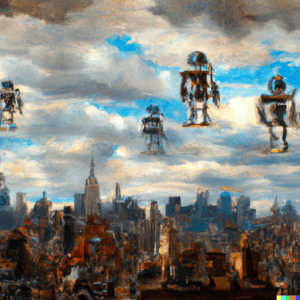
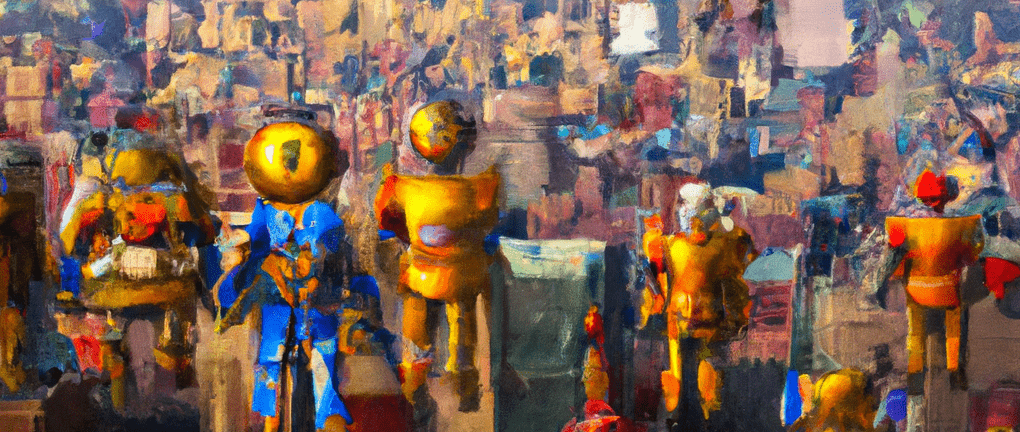
This essay includes AI generated art from DALL-E (now part of GPT). If you want to see my thoughts on generative art, what we should be doing, and what I’m doing, see https://robertgeraci.com/2023/11/14/ai-art-and-the-ethics-of-powerpoint-etc/
As I think about the public excitement over artificial intelligence (AI), my base proposition is that how we talk about a technology affects what we will do with it, and thus what world we create with it. Most of the current language around AI derives from mythological expectations that we can build godlike machines and become godlike ourselves – what I’ve called Apocalyptic AI. You can see this language everywhere from discussions of OpenAI to Hollywood blockbusters. Can we find relevant values beyond the dream of AI transcendence that has overtaken Silicon Valley entrepreneurship? I recommend we get invested in the process of sorting out worthwhile values and their specific relevance to AI, a process better done when we think outside the current ideological ecosystem. We need an international conversation about our unique cultural values and how those apply to our global questions.
These values are important, because we are enmeshed (already too late) in discussions of AI ethics and the horizon for discussions about AI safety might be closing. The fight over ethics and safety might seem arcane to those outside the AI and AI-adjacent fields, but it’s really quite simple. AI ethics is about how we’ll design and deploy AI technologies – everything from eliminating unwanted bias from algorithms to making sure that AI doesn’t lead to universal unemployment. AI safety, on the other hand, refers to Terminator-like scenarios where we must fret over the safety of humanity. Will the machines kill us all, either deliberately or inadvertently?
 AI safety questions are usually overblown. Skynet isn’t particularly likely, that’s why they made movies about it. Even less likely is Eliezer Yudkowsky’s “paperclip maximizer,” an hypothetical machine with transcendent intelligence asked to make paperclips. Somehow, it would decide that the best way to do so would be to eliminate guardrails on its own operation, including humanity, and turn the entire world into paperclips. While I can appreciate that Yudkowski wants us to contemplate whether our safety is meaningfully one of the values possessed by intelligent AI, the example is hyperbolic and distracts us from real issues. And yet it is cited routinely, usually in its formulation by Nick Bostrom. While attending a conference in Thailand, I attempted to articulate the silliness of the argument in a bit of concept art.
While I am not particularly worried about AI safety, that’s largely because (a) AI ethics is pressing now and (b) getting AI ethics right would probably get AI safety right. It’s getting the ethics wrong that will lead to disaster if we ever see superintelligent AI: that’s one of the key ideas behind the depiction of “Vile Offspring” in Charles Stross’s wonderful science fiction novel, Accelerando. Right now, we’re heading that way. In part, I worry that AI seems to be nothing but a business plan (and I have a real objection to that…if the technology is nothing but a means to profit it won’t have many human-centered goals). Going further, however, I worry that we’re building AI to do bad things deliberately. Civitai, an online marketplace for sharing AI models, created a bounty for people to make deepfake images of real people, permitting (even if it is technically against the rules) the construction of nonconsensual sexual images in exchange for onsite rewards. In a world where things like revenge porn are becoming horrifically commonplace, now we will see opportunities to accelerate the power of cruelty. Simultaneously, human sins also get baked into AI by accident. Bias in algorithms designed to ease judicial, hiring, and banking decisions have all be shown to produce racist and sexist outcomes. Malfeasance with image editing and algorithmic bias are just two things happening now that challenge our ethical agendas. We could list a few dozen more at least. Those problems are already with us, and if we ever build superintelligent machines it sure would be good if we’ve solved the problems first – otherwise we can count on having an AI safety issue.
It’s tough to get a handle on these problems when we’re being constantly told that AI is the future, that AI will soon and inevitably be superintelligent, and that the destiny of the universe is in the hands of our machine progeny. If you haven’t already heard that a Singularity is coming – a moment when technological progress takes place so rapidly that you couldn’t possibly imagine the outcome – and that AI superintelligence is but a few years away, well, you’ll hear soon because those ideas are tightly linked with today’s AI ecosystem. For example, in late 2023 a Google search for “ChatGPT and Singularity” produced dozens, possibly hundreds of pages and articles debating the matter. By the time you read this, that number will likely be in the thousands and plausibly enhanced by a GPT-authored plethora of additional uncreative but innumerable bits of “content.” In November 2023, “Singularity” was in the top 1% of Reddit groups, and those groups debated the future of computers in long chains. The apocalyptic agenda dictates we will build superintelligent machines, they will remake the world in their image, and (most of the time) we will upload our minds into robot bodies so that we can join them in the future. There’s a chain tracing from 20th century science fiction (e.g., Frederick Pohl and AC Clarke) to 20th century scientists like Hans Moravec and then Ray Kurzweil, a chain that is now wrapped firmly around the ankles and wrists of Silicon Valley tech culture.
It used to be that this agenda was hidden, veiled in proper apocalyptic style, but now it has become outspoken and obvious. When OpenAI launched its brand-new corporate values in 2023 it centered those on “AGI focus.” That’s short for artificial general intelligence, and while it could refer to an AI that is able to do a wide variety of tasks (like a human, as opposed to the narrow capacities of something like AlphaGo), it generally refers to machines that are greater-than-human intellects rather than human-equivalent. It has been noted by Steven Levy that AGI is all over the terrain at OpenAI, and Louise Matsakis notes that for OpenAI “anything that doesn’t help with that is out of scope.” So the biggest splash in the AI industry has firmly committed to building our evolutionary successors.
To make progress back toward ethics, and thus toward the safety issue, requires rethinking our approach to culture and technological innovation. There is nothing necessary about the Singularity, AGI, or superintelligence. In Japan, for example, belief in these is rare. Scholars like Takeshi Kimura, Selma Šabanović, and Jennifer Robertson have all noted the relative disinterest among Japanese roboticists. Ideas might purport to be universal, but quite often they are local and only pretending toward universality. To lean on another scholar, Dipesh Chakrabarty, we must “provincialize” Silicon Valley. Just as Chakrabarty wanted everyone to know that the historical trajectory in Europe and N. America is one historical trajectory, not the historical trajectory. The whole world isn’t necessarily in a race to “catch up” to Europe and N. America; other places can have their own versions of modernity and engagements with technology. The folks at Silicon Valley might believe they’ve uncovered the way of understanding AI, but we should push back on that – Silicon Valley produces one way of understanding AI. This isn’t to say that all trajectories are equal in ethical, economic, or political outcomes; it’s just a starting point that says we cannot assume the default superiority of any particular culture, history, or perspective: even if that perspective does come with the prospect of trillion-dollar IPOs.
In my AI ethics work, I push back on Silicon Valley by (a) revealing the essential religiosity of the Singularity and (b) offering a few values from elsewhere around the world. That the Singularity is religious doesn’t make it wrong, but I’d like to see a more global conversation about what we want from our technologies, a conversation that must take place in public policy and in the public commons. I’ve done ethnographic research in India, where I twice lived as a Fulbright-Nehru scholar 1, and I’ve collaborated with a colleague in the Republic of Korea, which I’ve visited multiple times as part of our work together. These projects allowed me to learn from my many friends and acquaintances in both countries. From these partnerships, I’d like to take four cultural values and suggest that they each offer unique contributions to the way we think about AI.
In Korea, the value of jeong and the history of hwarangdo offer two very different, but very interesting perspectives on humanity. My collaborator, Prof. Yong Sup Song of Seoul Christian University, brought these values into my academic and personal life. We collaborated on jeong in an essay published by the longstanding journal, Religion, and we earned a collaborative research award from the American Academy of Religion which allowed him to visit my prior institution to speak about hwarangdo, developing ideas which fuel his forthcoming contribution to the Edward Elgar Handbook of Religion and AI (2027).
The first, jeong, is a complex feeling of interpersonal solidarity, one that goes beyond friendship or empathy to include also a sense of surviving together in hostile environmental conditions. Jeong includes the pursuit of common cause (even though sometimes the relationship is, itself, the fraught condition!), and is characterized by deep, “sticky” ties between people. It is rooted in the totality of positive and negative experiences, and it creates the necessity of reciprocity through the accumulation of emotion over time. Building AI to connect people in reciprocal relationships, possibly building AI so that it can “feel” a connection to people would be a far cry from the asymmetrical models of marketing that underlie “social” media like Facebook or Twitter. Building AI constrained by legitimate and accepted models of reciprocity and accumulated social ties could help us ascertain the legitimate constraints on surveillance rather than allow either capitalism or governmentality to run amok with our data. Building reward systems that enhance reciprocity in computers could be a powerful antidote to our current approach, but it would demand human changes also. After all, jeong is not limited to relationships with people, it includes the possibility of relationships with places and objects. And it would certainly be helpful in the advent of superintelligence if AI believes itself tied to us in a deep and reciprocal emotional bond. Given this, we had better begin behaving better ourselves. People’s treatment of the chatbot Tay and the robot Hitchbot indicate that we are at risk of teaching machines entirely the wrong kind of behavior.
We could also draw on Korean values to rethink more obvious dangers in the AI ethics sphere. For example, militaries around the world are in a race to “AI supremacy.” Building machines that are increasingly dangerous along with increasingly autonomous produces obvious risks for both AI ethics and AI safety. Guided by my friend, Prof. Song, I’ve been thinking about the hwarangdo military organization in ancient Korea. Hwarangdo was a youth organization that, while producing front-line soldiers, held a powerful value toward life. It emerged out of Korea’s religious syncretism of shamanism, Taoism, Buddhism, and Confucianism. Loosely speaking, the five precepts of hwarangdo are trust, loyalty, respect, refusal to retreat, and to never kill without just cause. But beyond these precepts, the hwarangdo were committed to the arts and to the celebration of life. They danced and sang and visited sacred spots in nature. It may seem absurd to imagine teaching military AI to dance and sing with us but, as Prof. Song notes, the viral enthusiasm for the dancing robots of Boston Dynamics shows that we human beings are certainly willing to entertain the possibility. In a world where robots already can (and soon will be) targeting opponents autonomously and patrolling battlefield environments, we must be sure that they value life, that they seek solutions beyond indiscriminate killing.
Both AI ethics and AI safety hew closely to questions of command and control, so out of India I draw lessons from its independence era: swaraj and swadeshi.
Swaraj means “self-rule,” and it can refer to self-mastery or self-control at several levels: individual, community, and nation. Gandhi considered national swaraj important, but less important than individual swaraj. The dangers of deepfakes, revenge porn, and fake news all speak to our desperate need for technological swaraj. Rather than using AI – as we’ve used many technologies before – to find ways of controlling others or, at least, ensuring that others are subject to the ever-present influence of corporate advertising and political campaigning, we should find ways to use AI to protect ourselves. AI could identify fake news, locate and address revenge porn, and generally work on behalf of its users. Such technologies could change the face of modern life for the considerable better.
The close companion of swaraj is swadeshi. In the first half of the twentieth century, Indians struggled with whether to buy foreign-made goods. The foreign goods were often better and always cheaper. It’s well-known that the Industrial Revolution brought economies of scale to British economic output, but the Crown made sure of its supremacy in the marketplace through decades of deskilling Indian workers and creating tariffs that destroyed Indian exports. So by the time Indians were seriously debating swaraj they were worried about the way their economy had been undermined and reflecting on what it would take to fix that. They developed the key goal of swadeshi, which means self-sufficiency. It might be with a goal of universal swadeshi that we begin contemplating how the deployment of AI will impact our economy. Universal unemployment, after all, is not a goal worth pursuing unless you’re already a tech billionaire with a fleet of yachts and safehouses around the world.
I’m not suggesting that with these four ideals I’ve solved either AI ethics or AI safety. I’ve tried to add a few stones to the bridge we are building, a different kind of story to the ones we are telling. There are important conversations to be had in academia, industry, and public policy. These conversations demand that we pursue clarity of values and discern which policies require shaping. I imagine that while we ask these questions and orient ourselves toward the future, we will find that the search for moral AI is very much about the search for moral humanity. That means our challenge is enormous, but the potential for our reward even more so.
Views and opinions expressed by authors and editors are their own and do not necessarily reflect the view of AI and Faith or any of its leadership.